Wednesday, March 7, 2012
Grains of Salt and the Formation of Planets
We've been watching the Discovery Channel series How the Universe Works. While a bit light on content and a tad repetitious, it also features amazing animations and lots of actual images we hadn't seen before.
One of the most interesting factoids involved a casual experiment on the International Space Station that solved the mystery of how planets form. Watch the clip above to find out!


Tuesday, February 21, 2012
Michio Kaku and Physics of the Future

The newest and most highly rated documentary series I could find was How the Universe Works from the Discovery Channel. The writing seems a tad light compared to the PBS series we are used to, but the animations and actual footage are stunning. As a visual learner myself I just rejoice when an animation makes it possible to grasp some concept that would be impossible to picture from a description on a page.
We've only seen two episodes, but both have featured someone I had heard of but never seen before: physicist Michio Kaku, one of the developers of string theory. And it just so happened that the Times Union featured an interview with Kaku in advance of his appearance at UAlbany. I thought it would be fun to run down there and attend the free lecture.
The topic was advanced physics -- mainly nanotechnology, in which UAlbany and the surrounding area are beginning to specialize. Kaku called the area "ground zero" for nano research. Still, even with the TU article, I was surprised to find that the ballroom on the Albany campus was standing room only. I counted more than a 1,000 people in the room. And amazingly, my son and I managed to find seats right up front.

Kaku presented some of the ideas from his new book, Physics of the Future. The lecture was interesting, even if some of the "future" technologies are already here (a phone that will make dinner reservations for you -- I believe it's called Siri) or seem as likely as the jetpack we were all promised back when I was a kid. Underscoring the reality of what "could" be with what probably "will" be was the primitive projection system in the ballroom, which made it hard for Kaku to show a video clip after his Power Point presentation. Looking around the room during the lecture at the rattling curtains and the chandeliers hanging scarily askew -- looking like they hadn't been updated since I went there 35 years ago -- it made me wonder how this country can try to take the lead in technology when our infrastructure is allowed to crumble.
Still, it was a fun jaunt, the lecture was entertaining, and although we decided not to battle the crowds to buy a book and get it autographed, I think I will try to borrow a copy from the library as soon as I get the chance.
My favorite takeaway from the evening came with the last question: Asked what he thought was the most important discovery of the last few years, Kaku pointed out that every science textbook which claims that everything in the universe is made of atoms was wrong. In fact, he said, atoms only account for 4 percent of the universe. The rest is made up of dark matter and dark energy. Sitting there following the discussion, I felt that it was a validation that I made the right choice when I decided that our study of physics would focus on the latest discoveries rather than rehashing Newton's Laws yet again.
Sunday, January 8, 2012
We've Been Building Robots...

The other book is a joint project with the other editors of GeekMom! I'll post more news of that as it develops.
Sunday, August 28, 2011
More Integrated Science
The Ceceri family will be continuing our study of Integrated Science this year, but with one less student. John III is now off at Rochester Institute of Technology, where he is in the Interactive Games and Media program.
As a going-away present, I made him this great fish tank, using genetically-modified fluorescent GloFish. Watch the video to see what happens when you turn on a blacklight!
The mini-aquarium I put together is a project I've written about before on Home Biology. Here are the instructions, which I ran on GeekMom last week.
Keep watching this space for more labs related to the Joy of Science video series. We'll also be trying out some electronics projects as I work on a new children's activity book about robotics. I'm looking forward to another fun year!
Friday, June 17, 2011
Foam Plate Speakers


For science this week, we decided to experiment more with audio devices. (The episode of The Joy of Science we had just watched was about properties of matter, including magnetism, and mentioned that speakers worked because magnets changed shaped.) Since we had already built a radio, this time we built a speaker. The speaker was much easier to make and much less elaborate than the radio, and we were able to have it working in about a half-hour. Despite requiring some fine-tuning, we were able to get it to work very well.
This simple and elegant project was designed by Jose Pino. You can see it being made in this Make Magazine YouTube tutorial.
We didn't test our speaker out with our foxhole radio, because the volume is so low on both devices. Instead we used an mp3 player. But we plan to try our homemade radio with the speaker sometime in the future.
 Materials:
A foam plate
Two strips of paper
Two business cards (we just cut an index card in half for this)
Tape
A hot glue gun
Magnetic copper wire (Jose Pino recommends using AWG 32)
Neodymium magnets
An audio plug
A piece of cardboard
1. We started by rolling one of the strips of paper over the magnets. We then taped the roll closed, being careful not to tape it to the magnets.
2. Next, we rolled the other strip of paper around the first strip, and taped it closed. We cut this strip a little less wide than the first. This made the outer strip stick out a bit more than the inner one.
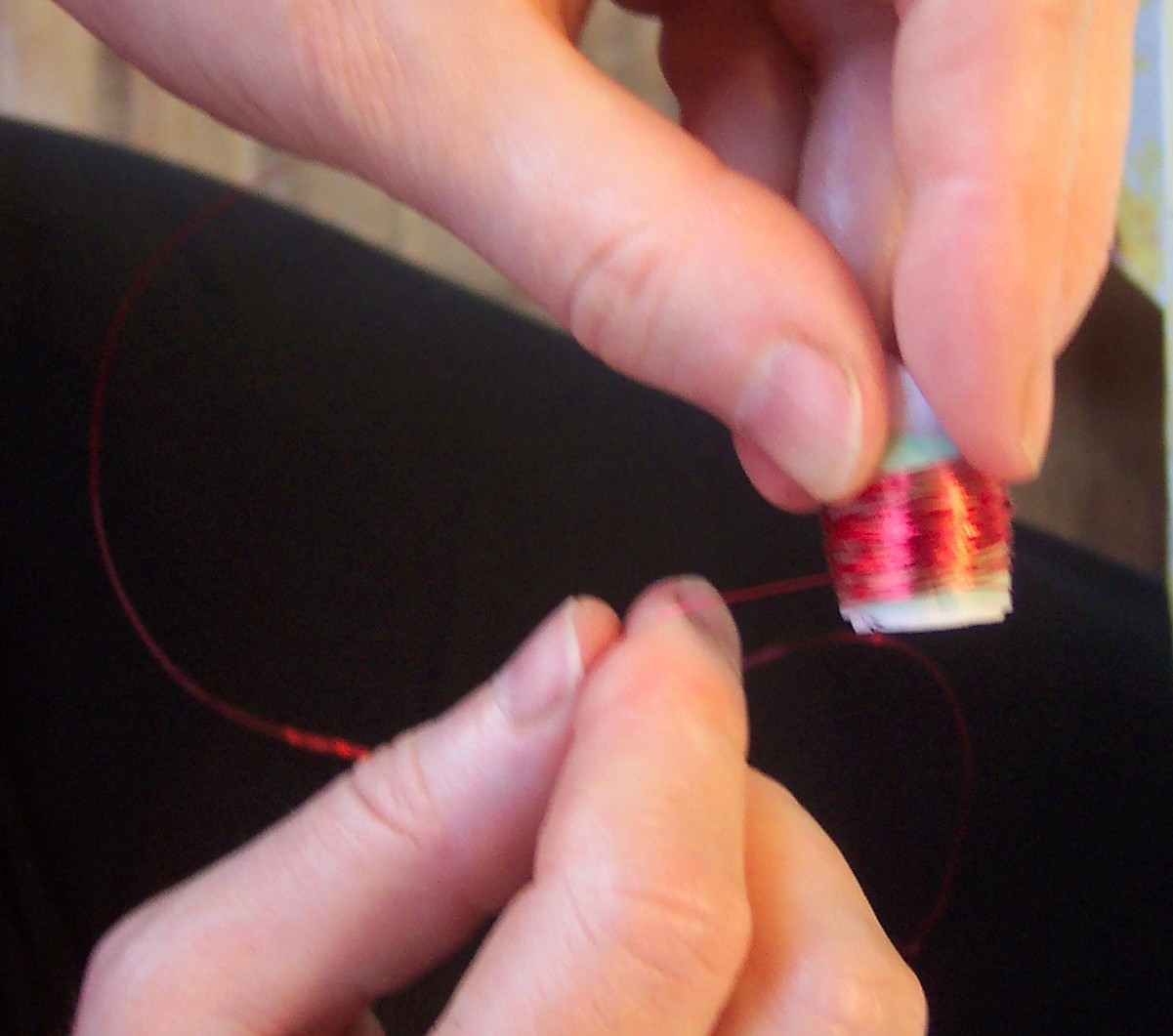 3. Keeping the magnet inside the tubes of paper, we coiled the copper wire around it, using about 50 turns. Leave a few inches of copper wire uncoiled on each end.
4. We then pulled the magnet out of our paper, along with the inner strip (we made it wider so that it would be easier to pull out.)
5. Discarding the inner strip, we then hot-glued the outer to the bottom of the foam plate, being careful to have it in the center.
6. Next, we hot-glued the magnet to the cardboard. After that, we folded the business cards in an accordion shape, we glued them to the bottom of the plate, one on each side of the coil. We then put hot glue on the bottoms of the cards, and glued them to the cardboard base, making sure that the coil would go over the magnet.
7. We tested the wires by touching the ends to either end of a battery. This is what happened:

8. To connect our speaker to a sound system, we needed an audio plug. We got one by cutting the end off a cheap set of earbuds from the dollar store. FIrst we had to sand off the coating from each end of the copper coil wire and strip the rubber insulation from the ends of the audio plug. Because the earbuds were stereo, we needed to connect one wire from each earbud to each of the copper coil wires in order to hear both sides. (We're not sure that worked well, though.)
9. Finally, we plugged the audio wire into a music device. We found that MP3 players worked the best.
How it Works:
The speakers operate largely on the same principle as the piezoelectric earpiece we used in our radio experiment. The coil serves as an electromagnet. It receives electrical currents from the audio plug, which gives it either a stronger or weaker attraction to the magnets. This causes the foam plate to bounce up and down, creating sound vibrations.
Monday, May 23, 2011
More Plasma Fun
We had so much fun playing with our plasma ball, we decided to try making some plasma of our own! According to YouTube, this is easy to do if you have (a) a microwave and (b) a grape. This experiment was about the most exciting thing we have ever tried in our kitchen. Here's how to do it:


- large juicy grape
- knife
- microwave-safe plate
- microwave-safe tall heavy glass, preferably tapered (like a beer or coke glass)
- Cut a grape in half across the middle. Take one half and cut the long way, leaving a bit of skin to hold the halves together.
- Open up the halves and place grape on a small plate. Remove the rotating turntable in the microwave. Place the plate in the microwave.
- Turn off the lights. Set the microwave for 5 seconds (but stand by to hit "Stop" when needed). You should see sparks and a puff of “flame.” That is the plasma.

Here's something even cooler: To make a kind of Jacob's Ladder, cover the grape with the glass. Make sure the glass is sturdy, or it may break! Set the microwave for 5 seconds (but stand by to hit "Stop" when needed). You should see blobs of plasma rising in the glass over and over.
Here's an explanation of how a microwave creates plasma from Naked Scientists:
A microwave oven heats up food using microwaves - these are electomagnetic waves that cause electric current to move back and forth between the two halves of the grape. This current is concentrated in the piece of skin between the two, which will heat up and dry out. The current then has to move through the air, creating a spark.
The spark is created when the electric field rips electrons off atoms. These can then move freely and carry electric current. A gas with free electrons and positive ions is also known as a plasma. This plasma conducts electricity and can absorb microwaves. Sometimes the plasma gets big enough to absorb enough microwaves to keep growing.
And from Physics Forums:
There's two clean grape surfaces that are separated by a fraction of a millimeter near the corner of an air wedge. The electric field between the grape portions at the tip of the wedge is large enough to cause breakdown in the air gap, making a plasma ball there.
Thursday, May 5, 2011
Plasma: The Fourth State of Matter

This week's episode of The Joy of Science was about States of Matter. Most people are familiar with three: solid, liquid, and gas. But there is a fourth state of matter: plasma.
Plasma is a gas-like field made up of charged atomic particles – negative electrons and positive ions (atoms which have lost some of their electrons, and so have an excess of positrons). As they move, these particles generate electricity and magnetic fields. Plasma requires low pressure and extremely high temperatures. On Earth, plasma only occurs naturally in the form of lightning, polar auroras, and extremely hot flames. However, plasma is actually the most common state of matter in the universe, since it makes up stars and other celestial bodies, as well as the space in between.
Plasma was first identified in 1879 by Sir William Crookes, who called it "radiant matter." It can be created artificially by running an alternating electric current through certain types of gas in vacuum tubes. This “knocks electrons” off the atoms inside.
In this experiment, we decided to use a plasma globe to observe some properties of plasma. A plasma globe is a type of lamp that you can buy in a novelty shop, museum gift shop, or through a science supply house. Inside the glass bulb of the plasma globe is a Tesla coil. This creates a plasma field of electrically charged particles, which look like small tendrils of lightning.

When we turned the plasma globe on and touched the glass, the tendrils of lightning concentrated at the spot that was touched. Touching it in more than one place at the same time created several points of concentration. Our plasma globe also had a setting that made it react to sound waves. We put mp3 speakers next to it and watched it flick on and off in relation to the music. Interestingly, it was more affected by frequency (how high or low the note was) than to volume. It reacted very strongly to particular notes and not at all to others. This reminded us of seeing the band ArcAttack at Maker Faire NY. ArcAttack creates music using giant Tesla coil-driven plasma arc speakers.
The first experiment we did was to hold different kinds of unplugged light bulbs near the globe. As described on the Plasma Ball experiments page on the Wonders of Science website from the University of Wisconsin, some electrons from inside the globe travel through the glass to the light bulbs.

Inside the bulbs are gas molecules. In fluourescent bulbs, molecules of mercury vapor become excited by the energy of the charged particles bombarding them from the plasma field. Electrons in the mercury atoms make a quantum jump to a higher energy level (or shell) around the atom's nucleus. When they return to their previous energy level, the extra energy is given off in the form of light. When they are plugged in, fluourescent tubes also operate by creating plasma fields out of the mercury gas.
We got good results with fluorescent and neon lights, above and in the videos below. We also tested Halogen and Xenon bulbs, but were unsuccessful.
Our second experiment was more elaborate. First, we balanced a penny on the top of the globe. Next, we took another penny, and close to the penny balanced on the dome, but not touching it. As in the first experiment, some electrons from the plasma field traveled through glass and were carried by the penny on top as an electrical current. The penny was able to carry a current because they are made out of a conductive material, copper. Holding a second penny above the first drew the electricity throught the air, creating a tiny spark. You can just barely see the spark in the photo below; in the video you can see and hear the tiny crackle as the pennies spark.

We also tried sending sparks to our fingers. We found that, if we weren’t grounded, we could send a spark from the penny to one of our fingers without feeling a shock!
Stay tuned for more exciting plasma experiments in the second part of our report on States of Matter!
Subscribe to:
Posts (Atom)